

The Amenaprkich Khachkar of Haghpat
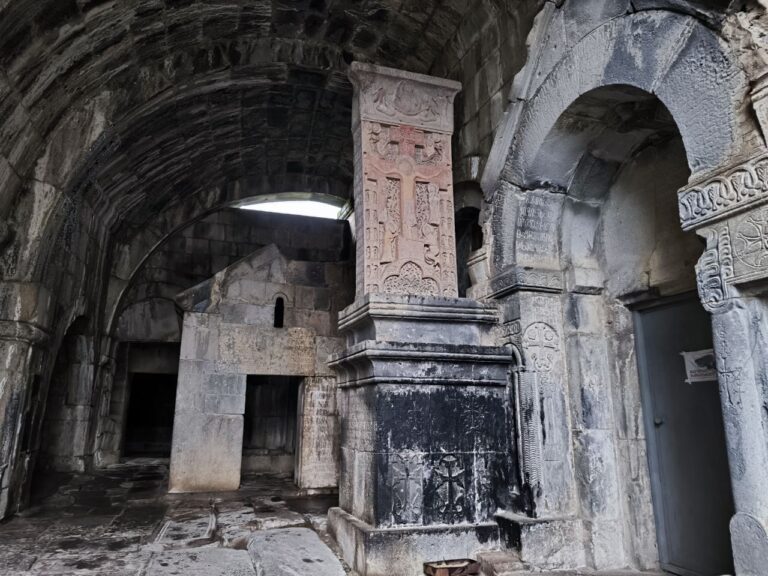
One of Armenia’s most unique and famous monuments is the Amenaprkich (All-Savior) Khachkar of Haghpat. It is a high-value specimen of Armenian khachkar craftsmanship, very few of which were created and have survived. It is located in the Small Vestibule (Pokr Zhamatun), situated between the Church of Surb Nshan and the Great Gavit of Haghpat Monastery. The khachkar received the name Amenaprkich because the monument depicts the Savior of Christians, Jesus Christ.
History
The original building of the Haghpat Monastery library was built in the 11th century. It was reconstructed and given a more beautiful appearance in the 13th century at the initiative of the monastery’s leader, Archbishop Hovhannes. The inscription regarding the construction was carved on the back of a basalt khachkar. However, a few years later, in 1273, by the order of Archbishop Hovhannes, a larger and more valuable Amenaprkich khachkar was erected, on the back of which the inscription of the library’s reconstruction was carved with almost the same content. The old khachkar is currently located near the entrance of the library, leaning against the wall, not far from the Amenaprkich khachkar. The inscriptions on the Amenaprkich khachkar do not contain the name of the monument’s author. Eight years after the creation of the Haghpat khachkar, in 1281, another similar khachkar was erected in the village of Dsegh, the author of which is the sculptor Vahram. Considering the similarities in inscriptions, ornaments, and style of the two khachkars, it can be considered that both monuments are the work of the same author.
Architectural Description
The Amenaprkich khachkar of Haghpat is placed on a high pedestal built adjacent to the outer wall of the Surb Nshan Church. This khachkar has no predecessor. It became the foundation of a new direction in khachkar craftsmanship. Such khachkars later became known by the name “Amenaprkich khachkars.” On Armenian khachkars, the symbol of Christianity, the sign of the cross, is carved in various solutions, while figures of people or animals are almost absent. Exceptions are the rarely encountered reliefs of angels. The Amenaprkich khachkar of Haghpat differs in its stylistic solutions. The figure of Christ is depicted in full height on the cross. Around Him are depicted two Biblical characters—the mother of Christ and Mary Magdalene—as well as the 12 apostles, saints, and angels. Another unique feature of this khachkar is that there are numerous inscriptions on the front side, which also contain fragments of prayers. In essence, these writings are explanatory captions for the sculptures on the khachkar and are an inseparable part of them. There are also inscriptions on the pedestal of the khachkar. It mentions the orchards and estates donated to the Haghpat Monastery.
Warning
It is strictly forbidden to light candles on the pedestal of the Amenaprkich khachkar or directly in front of it. The melted wax is absorbed into the stone, damaging it, and the fire blackens and heat-damages the stone, thereby harming the 13th-century monument.